Visiting Knossos: Tickets, Timing and the Heraklion Museum
Last updated: November 2026
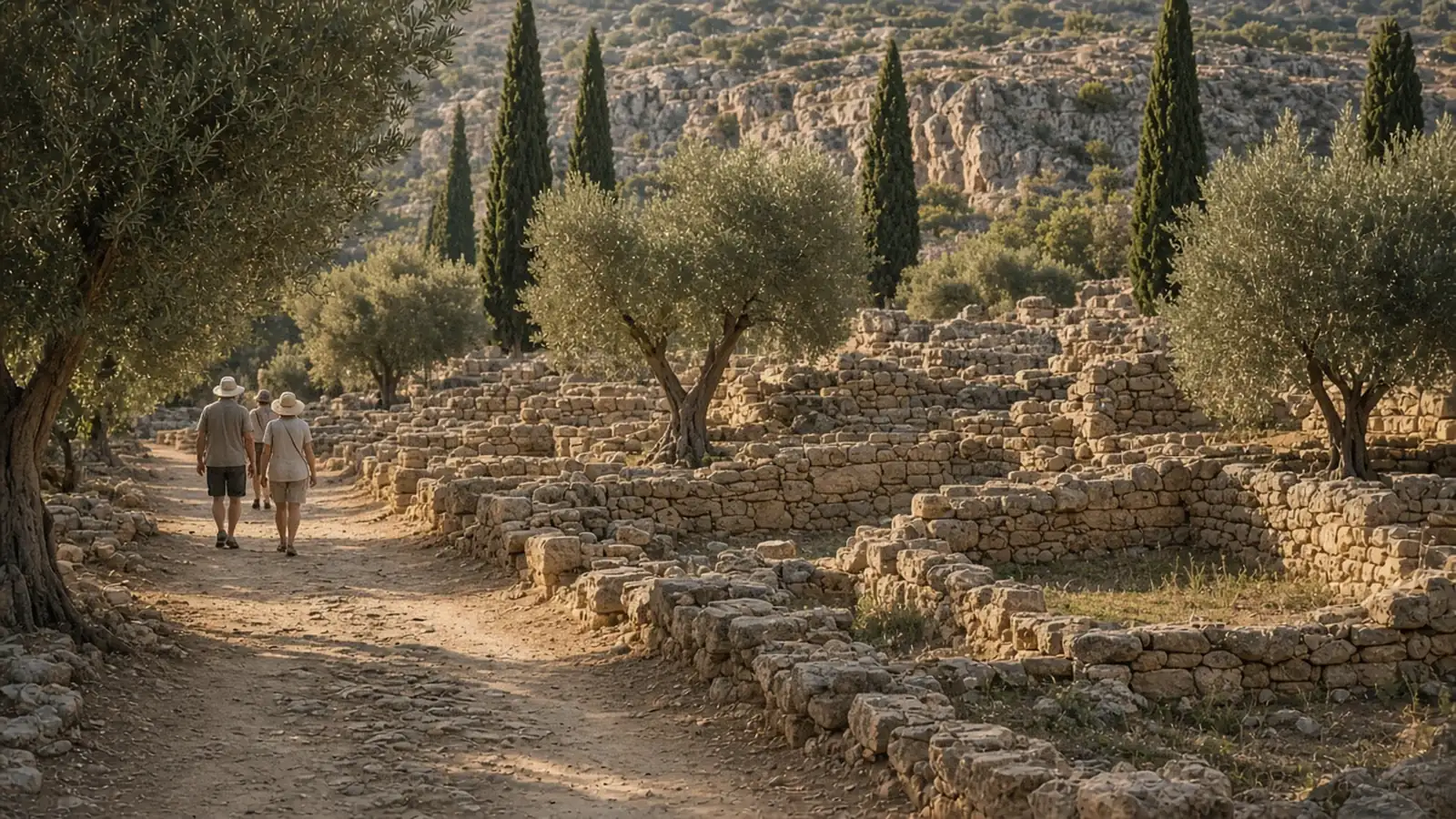
Short version: buy the official e-ticket on hh.gr, be at the gate when it opens or come in the last two hours, allow about two hours on site, and pair it with the Heraklion Archaeological Museum, where the original frescoes and finds are kept. Knossos is a short drive or city-bus ride from Heraklion.
Knossos is the most famous Bronze Age site in Greece and the main reason many people spend a day in central Crete. It is also easy to visit badly: in the midday heat, in a queue, without knowing that most of the colour you see is a modern copy. This guide covers the practical side. For where to base yourself, see our where to stay in Crete guide and the Crete travel guide.
Before you travel: fares, schedules, opening hours, tax rates and seasonal rules change often, and the details on this page may be out of date. Always confirm current prices, times and rules with the operator or the official site, or locally, before you travel.
Knossos at a glance
| Details | |
|---|---|
| What it is | The largest Minoan palace on Crete, on the Kephala hill just south of Heraklion |
| Status | Part of the UNESCO World Heritage property “Minoan Palatial Centres” (inscribed 2025, with Phaistos, Malia, Zakros, Zominthos and Kydonia) |
| Ticket (official) | €20 full, €10 reduced (hh.gr) |
| Summer hours | Daily 08:00-20:00 from 1 April to 31 August, closing earlier in steps through September and October |
| Winter hours | 1 November to 31 March, closing at 17:00 (see the note on opening time below) |
| Time on site | About 1.5 to 2 hours |
| Getting there | About 15 minutes by car or 20 minutes by city bus from Heraklion (hh.gr) |
| Pair it with | Heraklion Archaeological Museum: €20 full, €12 reduced (hh.gr) |
Prices and hours as listed on the official Hellenic Heritage Knossos page and Heraklion museum page, read 12 November 2026.
Check locally: these fares, times and dates may be out of date. Confirm them with the operator or the official site, or locally, before you travel.
Is Knossos worth it?
Yes, if you go with the right expectations. Knossos was lived in from the Neolithic to Roman times, but its great age was the Minoan period, roughly 2000 to 1350 BC. A first palace rose around 2000-1900 BC, was destroyed by an earthquake around 1700 BC and replaced by an even larger one. The site covers about 22,000 square metres and wraps around a big central court, with wings of storerooms, halls, light wells and stairways that make the Labyrinth myth easy to imagine.
The honest caveat is that much of what you see was rebuilt. The British archaeologist Arthur Evans excavated here from 1900 to 1931, after earlier digs by the Cretan merchant Minos Kalokairinos in 1878, and he reconstructed parts of the palace in concrete, with painted columns and copies of frescoes. Archaeologists have argued about those reconstructions ever since. They do help you picture the building in use, and the red columns have become Knossos’ trademark. If you want an unrestored palace, add Phaistos (see below).
Who might skip it: anyone who dislikes crowds and can only go at midday in July or August, or anyone with limited mobility who cannot manage uneven paths, steps and gravel in full sun. There is little shade on site.
Tickets and opening hours
Buy from the official source. Greek state site tickets are sold by Hellenic Heritage (hh.gr), run by the state agency ODAP, and at the ticket office. Sites with Knossos in their name are not necessarily official, and resellers usually charge above face value. The official e-ticket is for a time slot: the e-ticket site says that for sites other than the Acropolis, the ticket is valid from an hour before to an hour after the slot you pick.
| Period | Knossos hours (hh.gr) |
|---|---|
| 1 April – 31 August | 08:00-20:00 |
| 1-15 September | 08:00-19:30 |
| 16-30 September | 08:00-19:00 |
| 1-15 October | 08:00-18:30 |
| 16-31 October | 08:00-18:00 |
| 1 November – 31 March | Until 17:00 |
| Closed | 1 January, 25 March, 1 May, Easter Sunday, 25 and 26 December |
Source: hh.gr Knossos page, read 12 November 2026. Last admission is shortly before closing.
Check locally: these fares, times and dates may be out of date. Confirm them with the operator or the official site, or locally, before you travel.
Two small conflicts between official listings are worth knowing. For winter, hh.gr gives 08:00-17:00 while the culture ministry’s Odysseus listing gives 08:30-17:00, so plan on the later start. Last entry is 20 minutes before closing on hh.gr and 15 minutes on Odysseus: arrive with more time than either.
Easter 2027 warning: Orthodox Easter Sunday 2027 is 2 May, so Holy Saturday falls on 1 May, which is also a listed closing day. On the official lists, Knossos is closed on both 1 and 2 May 2027. If you are in Crete over Easter, plan Knossos for earlier in the week.
Free days. Entry is free for everyone on 6 March, 18 April, 18 May, the last weekend of September and 28 October, and on the first and third Sunday of each month from November to March (hh.gr). Free days are busy. Several groups, including young EU citizens and children, qualify for free or reduced entry with ID; the categories are listed on hh.gr.
Best time to go
Time of day matters more than month. Coaches from the resorts tend to arrive mid-morning, and the site is exposed, so go at opening time or in the last two hours before closing. In summer the late slot gives softer light and a cooler walk; in winter, with a 17:00 close, go in the morning.
Season: April, May, late September and October are the most comfortable. July and August are hot and crowded; bring a hat, sun cream and more water than you think. Winter is quiet and often pleasant, though rain can make paths slippery, and the site occasionally closes early in bad weather (the Ephorate closed it from 14:00 on 3 October 2026, for example, as noted on the Odysseus listing). See April, May and October for what else to expect.
Getting there from Heraklion and the resorts
| How | What to know |
|---|---|
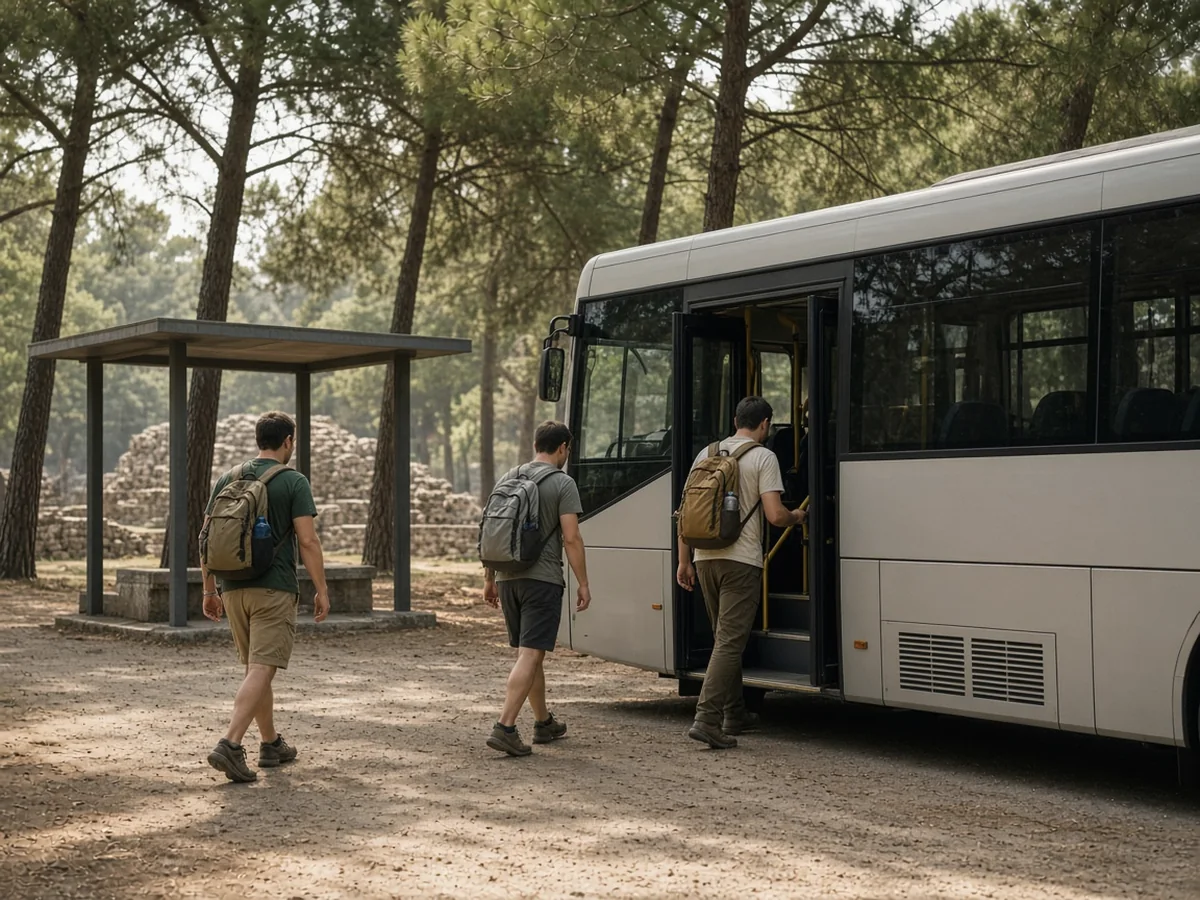
| City bus | Heraklion city buses run to Knossos; hh.gr gives about 20 minutes. check current routes and times with Astiko Heraklion (city buses) |
| Car | About 15 minutes from the city (hh.gr). There is parking near the entrance; it can fill up by mid-morning |
| Taxi | Easy from central Heraklion; agree the return or ask the driver for a number |
| From Chania, Rethymno or the east | KTEL intercity buses run to Heraklion, then change to the city bus. check current times with KTEL Heraklion-Lasithi |
| Organised tour | Coach plus guide from many resorts; convenient but usually arrives at the busiest time |
Check locally: these fares, times and dates may be out of date. Confirm them with the operator or the official site, or locally, before you travel.
From Chania it is a long day, so base yourself near Heraklion if you can. Our Crete by bus guide explains the KTEL network and how many days in Crete helps you decide whether central Crete fits your trip.
What to see at Knossos
There is no single fixed route, and parts of the palace are seen from walkways and platforms rather than walked through. Signs are fairly brief, so a guide, an audio guide or a good map helps. These are the places most visitors look for:
- The central court: the big open rectangle at the heart of the palace, and the easiest place to get your bearings.
- The Throne Room: a small chamber with a gypsum (alabaster) throne and benches along the walls, with copies of griffin frescoes. You usually look in from the entrance, and queues form here.
- The north entrance: with a reconstructed portico and a copy of the charging-bull relief fresco, one of the most photographed corners.
- The royal apartments and the Grand Staircase: the east wing’s light wells and stairs, and the room with the dolphin fresco copy. Access depends on conservation work on the day.
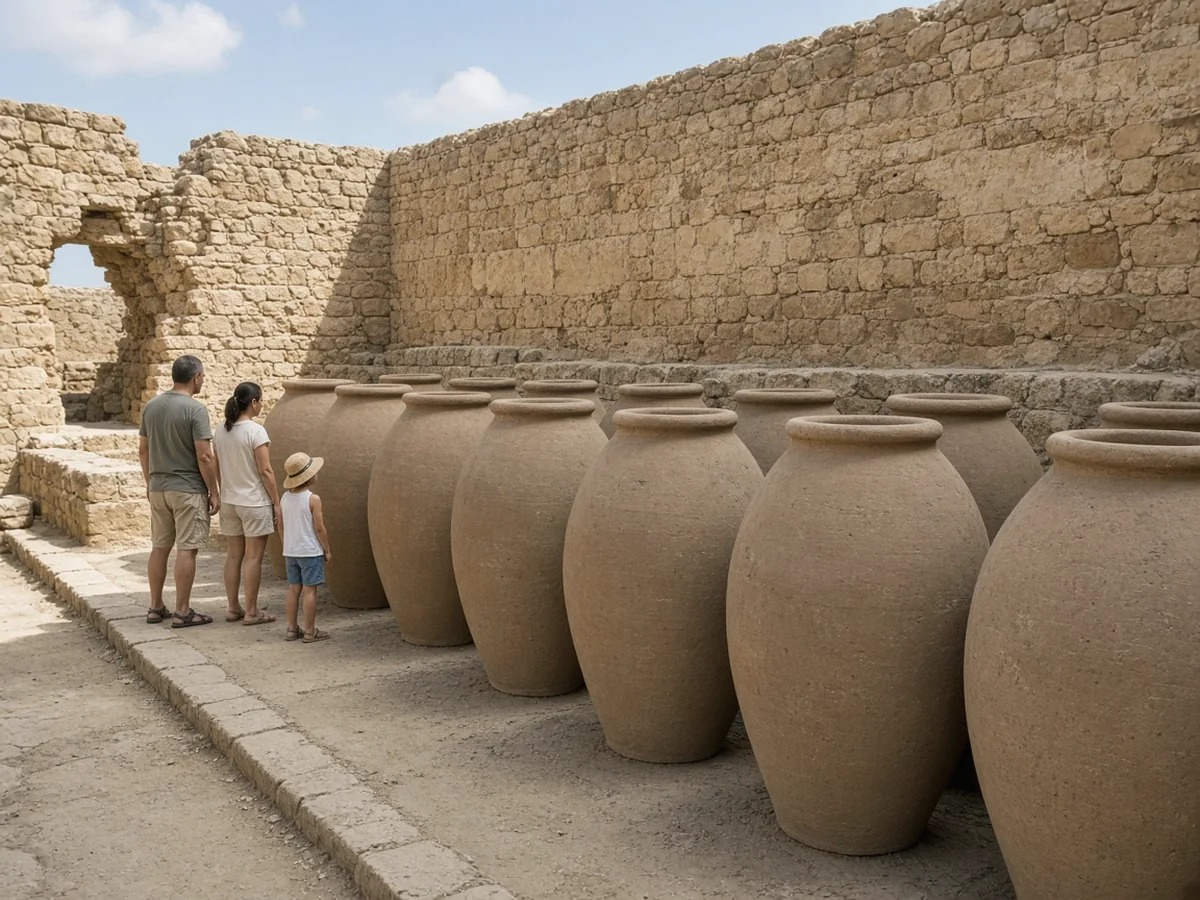
- The storerooms (magazines): long corridors lined with giant clay jars (pithoi) that held oil, wine and grain.
- The theatral area and the Royal Road: stepped stone seating and an ancient paved road leading away from the palace.
- The south propylaeum: where a copy of the procession fresco shows the figures who once lined the approach.
Most of the frescoes on the walls are copies; the originals are in the Heraklion museum. That is why the two visits belong together.
The Heraklion Archaeological Museum
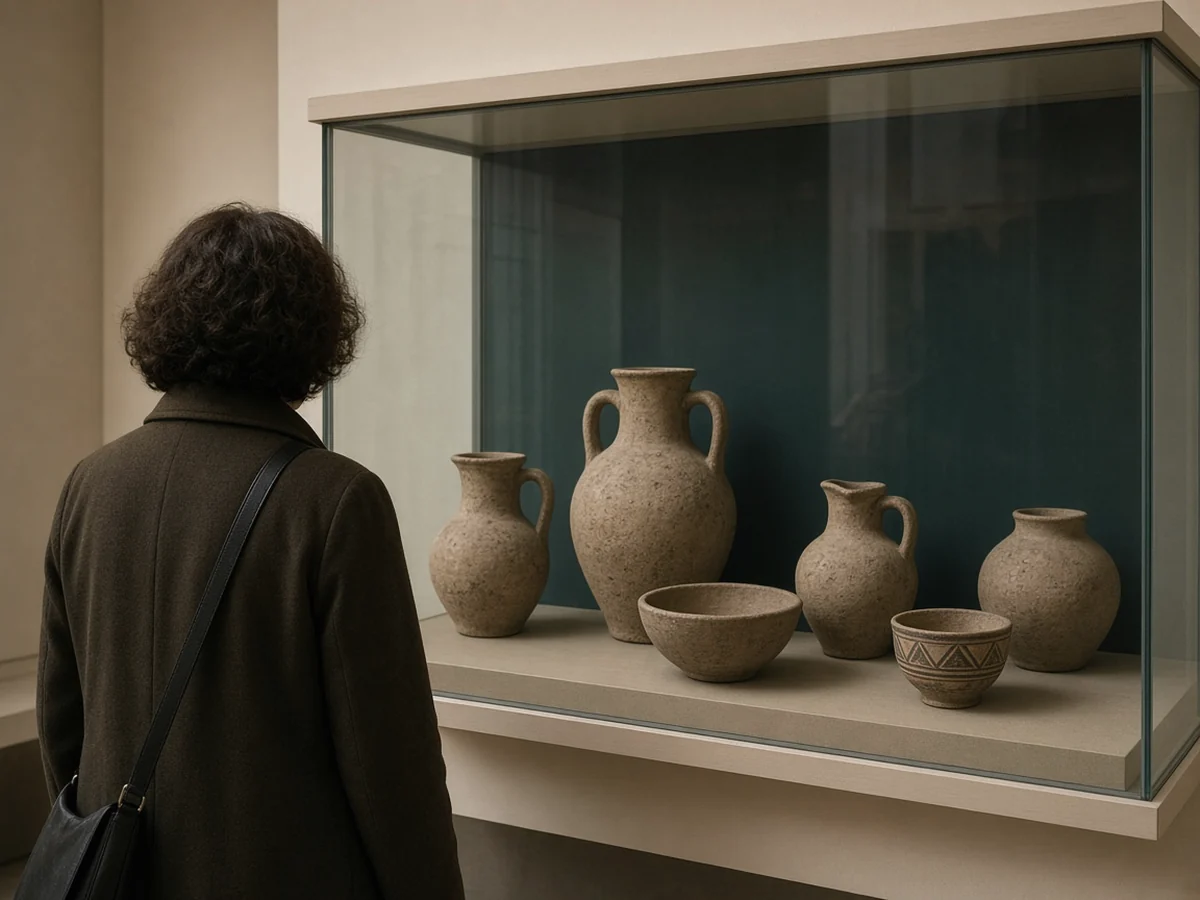
The Heraklion Archaeological Museum in the centre of Heraklion holds one of the great Bronze Age collections in the world, and it gives Knossos its meaning. Look for the original Knossos frescoes upstairs, the faience snake goddess figurines, the bull’s-head ritual vessel, the gold bee pendant from Malia and the clay Phaistos Disc, whose stamped signs have never been deciphered. Allow two to three hours.
| Period (2026-27) | Museum hours |
|---|---|
| Summer (to 31 October 2026) | 08:00-20:00; Wednesday 13:00-20:00 |
| Winter (1 November 2026 – 31 March 2027) | 08:30-15:30; Wednesday 10:00-17:00 |
| Tickets | €20 full, €12 reduced (reduced in winter for EU citizens over 65) |
| Closed | 1 January, 25 March, 1 May, Easter Sunday, 25 and 26 December |
Sources: the museum’s own visit page and hh.gr, read 12 November 2026. In 2026 the museum’s summer hours started on 28 April, not 1 April; check the 2027 start date.
Check locally: these fares, times and dates may be out of date. Confirm them with the operator or the official site, or locally, before you travel.
The museum opens on Tuesdays, unlike many Greek state museums. A good order is Knossos first thing, a long lunch in town, then the museum, or the other way round on a hot afternoon. On a winter weekday, remember the museum closes at 15:30, so do it in the morning and Knossos after. We could not confirm a combined Knossos and museum ticket on sale for 2027; buy two tickets unless hh.gr shows one.
Guide or no guide?
Knossos is a site where a good guide really changes the visit. The layout is confusing, the reconstructions need explaining, and a guide can untangle what is Minoan, what is Evans and what is myth. Licensed guides can be booked in advance, and many tours include the ticket. If you go alone, read up first, or use an audio guide or the official digital guide on your phone. With children, a short guided tour usually beats a long wander in the heat; see best Greek islands for families.
More Minoan sites
| Site | Why go | Ticket (hh.gr) |
|---|---|---|
| Phaistos | Unreconstructed palace on a ridge above the Messara plain, with big views; about an hour from Heraklion by car | €15 full, €8 reduced |
| Malia | Flat coastal palace east of Heraklion, easy to combine with a beach | Check hh.gr |
| Zakros | Remote palace in the far east, near a gorge walk and a quiet beach | Check hh.gr |
| Kydonia (Chania) | Excavations within Chania’s old town; part of the same UNESCO listing | Viewed from the street |
Phaistos price and hours from hh.gr Phaistos, read 12 November 2026. The six sites of the UNESCO “Minoan Palatial Centres” listing were inscribed in July 2025.
Check locally: these fares, times and dates may be out of date. Confirm them with the operator or the official site, or locally, before you travel.
Comparing Crete with other islands? See Crete vs Santorini.
A simple Knossos day
- Book a timed e-ticket on hh.gr for the opening slot (or the last two hours in summer).
- Take the city bus or drive from Heraklion; carry water, a hat and proper shoes.
- Spend 1.5 to 2 hours on site, starting at the central court.
- Lunch in Heraklion.
- Spend the afternoon (or, in winter, the next morning) at the Heraklion Archaeological Museum.
- Finish with a walk along the Venetian harbour to the Koules fortress.
Frequently asked questions
How much is a ticket to Knossos?
The official price is €20 full and €10 reduced, as listed on hh.gr in November 2026. Some groups enter free with ID, and everyone enters free on set days.
What are the Knossos opening hours?
From 1 April to 31 August it opens daily 08:00-20:00, then closes earlier in steps through September and October. From 1 November to 31 March it closes at 17:00. Check hh.gr before you go.
How long do you need at Knossos?
About 1.5 to 2 hours for the site, plus 2 to 3 hours for the Heraklion Archaeological Museum.
Do you need to book Knossos tickets in advance?
Not always, but buying a timed e-ticket on hh.gr a day or two ahead saves queuing in the sun, especially in summer.
How do you get to Knossos from Heraklion?
By city bus (about 20 minutes), by car (about 15 minutes) or by taxi. From Chania or Rethymno, take a KTEL bus to Heraklion and change.
Is Knossos open at Easter 2027?
Orthodox Easter Sunday is 2 May 2027 and 1 May is a listed closing day, so expect Knossos to be closed on both days. Check the official notice nearer the time.
Is Knossos worth it if it is so reconstructed?
For most visitors, yes. The reconstructions help you picture the palace, and the original finds are in the Heraklion museum. For an unrestored palace, visit Phaistos too.
Sources and useful links
- Hellenic Heritage: Knossos (hours, tickets)
- Ministry of Culture (Odysseus): Palace of Knossos
- Hellenic Heritage: Heraklion Archaeological Museum
- Heraklion Archaeological Museum: visit us
- Hellenic Heritage: Phaistos
- UNESCO: Minoan Palatial Centres
- Astiko Heraklion city buses
- KTEL Heraklion-Lasithi
Opening hours, ticket prices and holiday closures are set by the Greek Ministry of Culture and can change at short notice, including early closures for bad weather. Figures on this page are as listed on the official Hellenic Heritage (hh.gr) pages on 12 November 2026; check them again before you go.