Naxos Mountain Villages: Halki, Filoti and Apeiranthos in a Day
Last updated: October 2026
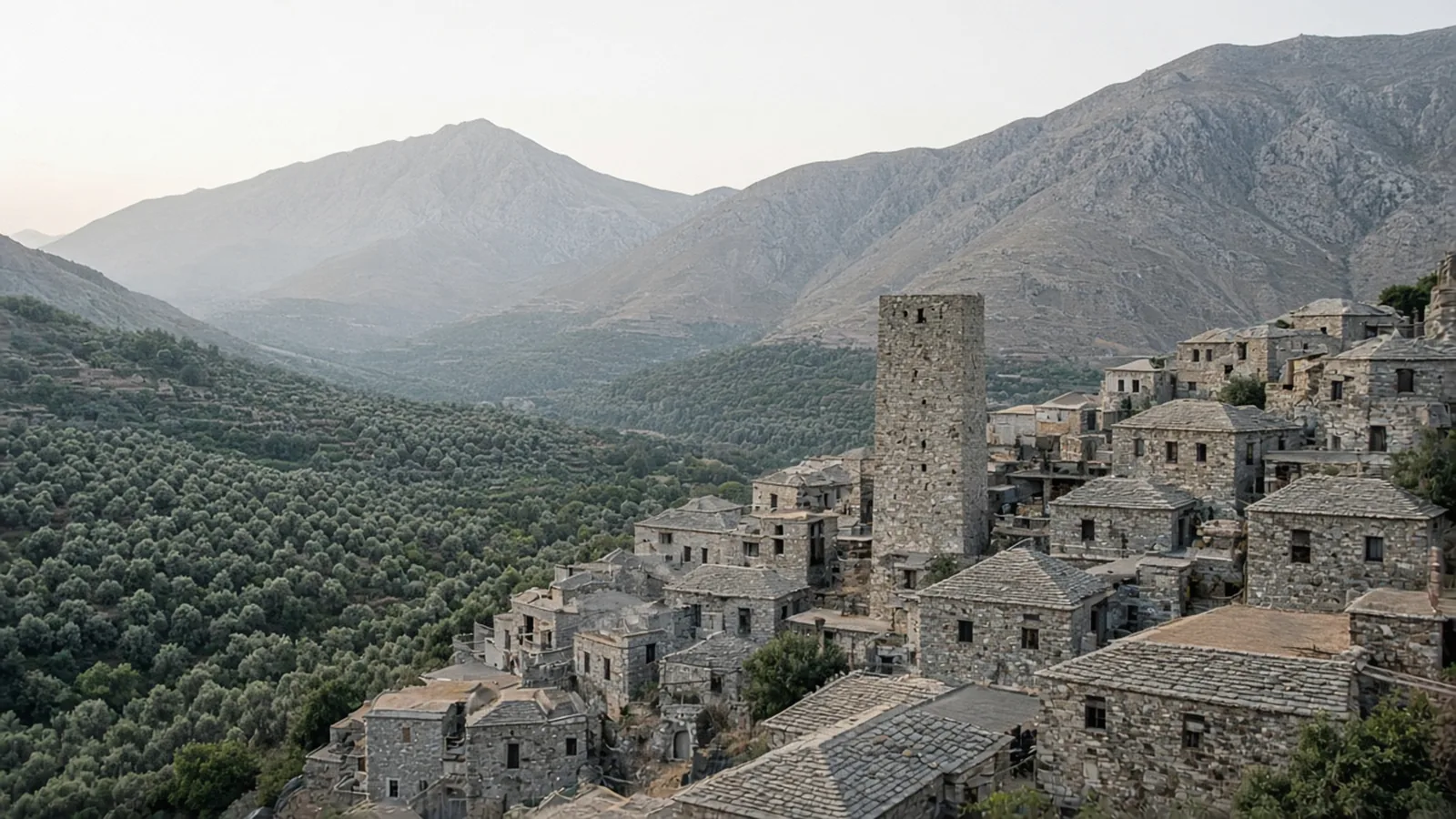
Halki, Filoti and Apeiranthos are the three classic mountain villages of Naxos, strung along one road through the island’s green centre. You can see all three in a day, by car or on the KTEL bus, with Byzantine churches, Venetian towers, a kitron distillery and marble-paved lanes on the way.
Most visitors to Naxos never leave the west-coast beaches, and they miss the best part of the island. The interior is a different world: olive groves, terraced hills, stone villages and the highest mountain in the Cyclades. This guide is a practical day loop of the three best-known villages, with timings, bus options and honest notes on what’s worth stopping for. For the island as a whole, see our Naxos travel guide; for where to base yourself, where to stay in Naxos.
Before you travel: fares and schedules change often, and the prices and times on this page may be out of date. Always confirm current prices and times with the operator, or locally at the port or bus station, before you travel.
Quick answer
The loop: Naxos Town → Halki (about 30 minutes) → Filoti (a few minutes on) → Apeiranthos (about an hour from town), then back the same way.
Best by car: you can add the Temple of Demeter, Panagia Drosiani and the Kouros of Flerio.
By bus: one KTEL line serves all three, with fares of €2.30 (Halki), €2.60 (Filoti) and €3.50 (Apeiranthos) one way.
Don’t miss: the Vallindras kitron distillery in Halki, the plane-tree square in Filoti, the marble lanes of Apeiranthos.
Allow: a full day. Start early in summer; museums and sites close mid-afternoon.
The loop at a glance
| Stop | From Naxos Town by bus | Feel | Highlights | Time to allow |
|---|---|---|---|---|
| Halki | About 30 min | Elegant former capital in an olive grove | Kitron distillery, Byzantine churches, the Barozzi–Gratsia tower | 1.5–2 hours |
| Filoti | About 35 min | Biggest village, lively square | Plane-tree square, Panagia Filotitissa, start of the Mount Zas paths | 1–2 hours (lunch) |
| Apeiranthos | About 1 hour | Stone and marble village at about 650 m | Marble-paved lanes, Zevgoli tower, small museums | 2 hours |
Bus times and village descriptions from KTEL Naxos (naxosbuses.com), checked 29 October 2026.
Check locally: these times and fares may be out of date. Confirm them with KTEL or at the bus station before you travel.

Halki (Chalki): the old capital
Halki, also called Tragea after the valley around it, was once the island’s administrative centre, and it shows: handsome neoclassical houses, small shops and cafes, all set in a huge olive grove. KTEL Naxos describes it as a ‘small lordly township’, and it’s the most polished of the three villages.
- Vallindras distillery: the family-run kitron distillery has been in Halki since 1896, according to the Naxos tourism site. Kitron is a liqueur made from the leaves of the citron tree; short visits usually end with a tasting.
- Byzantine churches: Panagia Protothroni, in the village, is one of the oldest churches on Naxos, with frescoes from several periods. Agios Georgios Diasoritis, just outside, has fine frescoes too.
- The Barozzi–Gratsia tower: a three-storey Venetian tower house, built in the 17th century by the Barozzi family (KTEL Naxos).
- An easy walk: the Region’s route 4 is a 6.2 km circuit from Halki through the Tragea olive grove to Panagia Drosiani and Moni, graded easy (officially 2 hr 10 min without stops).
Church opening is irregular: many are kept locked, or open only with a caretaker. Don’t build your day around getting inside one.
Filoti: the big village under Mount Zas
Filoti is the largest village on Naxos, about 19 km from Naxos Town, spread up the flank of Mount Zas among olive groves. Its heart is the square under a huge old plane tree, lined with cafes and tavernas, which makes it the natural lunch stop on the loop.
- Panagia Filotitissa: the village church, known for its white marble icon screen.
- The Barozzi tower: another Venetian-era tower, on the trail out of the village.
- Mount Zas: the highest mountain in the Cyclades rises right behind Filoti. Route 2, a circuit to the summit, starts at the eastern edge of the village. A full guide to hiking Mount Zas is coming soon.
- Practical: Filoti has shops, cafes and a bank, according to KTEL Naxos.

Apeiranthos: marble lanes and mountain air
Apeiranthos (locals often say Aperathou) sits at about 650 m on the slopes of Mount Fanari. Its narrow lanes are paved in marble and often covered by archways, and the houses have changed little since the Venetian era. It feels the most remote of the three, and it’s cooler up here in summer.
- Zevgoli tower: a 17th-century tower on a rock at the entrance to the village.
- Museums: the village has small archaeological, folk art, geological and natural history museums. The Archaeological Collection of Apeiranthos is open 08:30–15:30 (closed Tuesdays), with tickets at €5 (€3 reduced), according to the Ephorate of Antiquities of the Cyclades.
- Panagia Apeirathitissa: one of the island’s notable churches, with post-Byzantine icons and marble screens.
- A view: the chapel of Panagia Fanariotissa is about a 45-minute walk up from the village (KTEL Naxos).
- Walk to the coast: route 1 follows the old emery miners’ mule path down to Moutsouna on the east coast (11.47 km, officially 3 hr 45 min). Plan your way back before you set off.
Hours for the folk art, geological and natural history museums aren’t published in one place, and they’re small, volunteer-style collections, so treat them as a bonus.
Detours worth making
| Detour | Where | Why go | Notes |
|---|---|---|---|
| Temple of Demeter (Gyroulas) | Near Sangri, before Halki | A restored 6th-century BC marble temple with a small museum | 08:30–15:30, closed Tuesdays; €5 (€3 reduced) |
| Panagia Drosiani | Near Moni, just north of Halki | One of the oldest churches in the Cyclades, with early frescoes | On route 4 from Halki; opening irregular |
| Kouros of Flerio | Near Melanes | An unfinished archaic marble statue lying in an ancient quarry garden | On route 6 (Melanes–Flerio, about 2.5 km on foot) |
| Koronos | North of Apeiranthos | A stepped village on two mountain sides, with emery-mining history | About 1 hr 10 min from town by bus (€4.20) |
| Moutsouna | East coast below Apeiranthos | Old emery port and a quiet beach | Summer buses only twice a day in 2026 |
Sources: Ephorate of Antiquities of the Cyclades (Sangri hours and tickets, checked 29 October 2026); Region of South Aegean routes as summarised by islandpass.gr; KTEL Naxos route pages and summer 2026 timetable.
By car: a suggested day
- 09:00 Leave Naxos Town. Stop at the Temple of Demeter near Sangri (allow 45 minutes).
- 10:30 Halki: the distillery, a coffee and a walk to Panagia Protothroni.
- 12:00 Optional detour to Panagia Drosiani and Moni.
- 13:00 Lunch on the square in Filoti.
- 14:30 Apeiranthos: wander the lanes, see the archaeological collection before 15:30.
- 16:30 Drive back, or continue to Koronos, or down to Moutsouna for a late swim.
The roads are paved but winding, with tight bends and narrow village streets; park at the edge of each village and walk in. Thinking of hiring a car? See our Naxos guide for the pros and cons.
By bus: it works, with planning
One KTEL line runs from the bus station at the port in Naxos Town through Sangri, Halki and Filoti to Apeiranthos and on to Koronos and Apollonas. Buy tickets before you board, at the KTEL office or a ticket point: they can’t be bought on the bus. Children under 6 travel free, and students get 25% off (KTEL Naxos).
| Destination | Adult fare | Buses from Naxos Town (summer 2026) | Last buses back (summer 2026) |
|---|---|---|---|
| Halki | €2.30 | 8 a day, 07:30–20:15 | Departures from the village up to 21:45 |
| Filoti | €2.60 | 8 a day, 07:30–20:15 | Departures from the village up to 21:45 |
| Apeiranthos | €3.50 | 7 a day, 07:30–20:15 | Departures from the village up to 21:30 |
Source: KTEL Naxos fares and the timetable valid 29 June–30 August 2026 (naxosbuses.com). Spring, autumn and winter timetables have fewer buses.
Check locally: these times and fares may be out of date. Confirm them with KTEL or at the bus station before you travel.
A bus day that works (based on the summer 2026 timetable): take the 09:30 bus to Apeiranthos (about an hour), explore until the early afternoon bus down to Filoti for lunch, then a later bus to Halki and the evening bus back to town. Check the times on the day, because the stops are on the same line and buses run roughly every one to two hours.
For more on getting around without a car, see Greek islands without a car.

What to eat
Inland Naxos is farming country, and the food reflects it: local meat and charcoal grills, Naxian potatoes, and the island’s cheeses, including graviera, a hard cheese with protected designation of origin. Village tavernas on the squares in Halki, Filoti and Apeiranthos are the place for a long lunch. Finish with a glass of kitron, or take a bottle home from Halki.
When to go
- Spring (April–June): the best time. Wildflowers, green valleys, comfortable walking. See Greek islands in May.
- July and August: fine for the villages, which are cooler than the coast, but walk early and expect heat at midday. More buses run.
- September and October: warm days, harvests and quieter lanes. See September and October.
- Winter: the villages stay lived in, unlike many beach areas, but buses are fewer and some cafes close.
- Festivals: many villages hold a panigyri (saint’s-day festival) in summer, especially around 15 August. Ask locally.
Travelling with children? Our Naxos with kids guide suggests easy village stops. Comparing islands? Read Paros vs Naxos.
Frequently asked questions
Can you visit the Naxos mountain villages by bus?
Yes. One KTEL line runs from Naxos Town through Halki and Filoti to Apeiranthos. In summer 2026 there were 7–8 buses a day, with fares of €2.30 to Halki, €2.60 to Filoti and €3.50 to Apeiranthos. Buy tickets before boarding.
Which is the prettiest village in Naxos?
It’s a matter of taste. Apeiranthos has the marble-paved lanes and the most dramatic setting; Halki is the most elegant; Filoti has the liveliest square. Many people rate Apeiranthos highest.
How long does it take to see Halki, Filoti and Apeiranthos?
A full day. Halki is about 30 minutes from Naxos Town by bus and Apeiranthos about an hour. Allow one and a half to two hours in each village, plus lunch.
What is kitron?
A liqueur made from the leaves of the citron tree, a Naxos speciality. The Vallindras distillery in Halki has been making it since 1896, and visits usually include a tasting.
Do I need a car to explore inland Naxos?
No, but a car lets you add detours such as the Temple of Demeter, Panagia Drosiani and the Kouros of Flerio in the same day. The three main villages are all on one bus line.
Is Apeiranthos worth visiting?
Yes. Its marble lanes, archways and mountain views make it one of the most distinctive villages in the Cyclades. Go before mid-afternoon if you want to see the archaeological collection, which closes at 15:30.
Sources and useful links
- KTEL Naxos: routes, fares and timetables
- KTEL Naxos summer 2026 timetable (PDF)
- Ephorate of Antiquities of the Cyclades: hours and tickets
- Naxos and the Small Cyclades: Vallindras distillery
- islandpass.gr: Naxos walking routes (Region of South Aegean)
- Regional Unit of Naxos: Routes of Cultural Interest, in Greek
Bus timetables, opening hours and fares change by season. This independent guide is for planning; check the current KTEL Naxos timetable and site hours before you set out.